Liberation and Participation in the Cycle of Life (해탈과 생명순환)
(국선도 진기단법 집중 수련)
July 25, 2025 ~ March 11, 2026

Reflections on Recent Kouksundo (Sundo) Somatic Practice
Over the past eight months, I have been engaged in intensive Kouksundo (Sundo) practice, focusing particularly on Jinki Danbeop (眞氣丹法), an advanced breathing and internal cultivation method.
Many people initially approach Sundo as a health practice or breathing technique. Yet as practice deepens, it becomes clear that its purpose is far more profound.

The ultimate aim of Sundo practice is liberation (해탈) and conscious participation in the cycle of life (생명) through awakened awareness.
This perspective reflects a central insight of traditional Korean Taoist cultivation: human beings are not separate from nature but are living participants in the dynamic circulation of cosmic vitality (Kim, 2002).
1. Following Qi Rather Than Controlling It
A key principle of advanced Sundo practice is attunement to the natural movement of Qi (氣) within the body.
Instead of forcing breath or energy, the practitioner quietly observes the subtle flow of Qi in the abdomen. Awareness becomes calm, receptive, and respectful toward the internal life process.
This approach mirrors a classical Taoist principle: transformation occurs not through domination but through alignment with natural processes.
Over time, practitioners begin to experience Qi not as an abstract concept but as a living movement of vitality connecting body, mind, and environment.
Figure 1
Observing the natural movement of Qi during abdominal breathing practice

2. Breathing as a Reflection of Cosmic Rhythm
The breathing system used in this practice follows a structured cosmological rhythm.
The training framework includes:
• Five energetic layers
• Six developmental stages
• Nine meridian points
Each breath cycle follows a 12-count inhalation and 12-count exhalation, reflecting the cyclic rhythms found throughout nature.
During each cycle, awareness travels sequentially through nine energetic points along the body’s meridian pathways. Odd-numbered points are activated gently and subtly, while even-numbered points involve clearer energetic activation.
This alternating pattern balances receptive awareness and focused intention, allowing energy circulation to stabilize gradually.
Scientific research increasingly suggests that slow rhythmic breathing may regulate the autonomic nervous system and enhance emotional stability (Brown & Gerbarg, 2005).
Figure 2
Sequential awareness of nine energetic points during the breathing cycle

3. Expansion of Consciousness and the Spiritual Body
During the inhalation phase, awareness gradually expands beyond ordinary bodily identification.
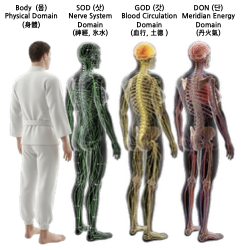
Traditional teachings describe three cores in the development of this trinity structure:
- SOD (삿, Cognition, Nerve System, Spirit, 氣) – The circulating vital energy that animates the body and connects internal life processes with the surrounding environment.
- GOD (갓, Affection, Blood Circulation, Mind, 神) – The refined spiritual consciousness that emerges as Jing and Qi are harmonized through sustained cultivation.
- DON (단, Psychomotor, Meridian Energy Center, Body, 精) –The foundational life essence stored and cultivated in the body, serving as the root of vitality and physical existence.
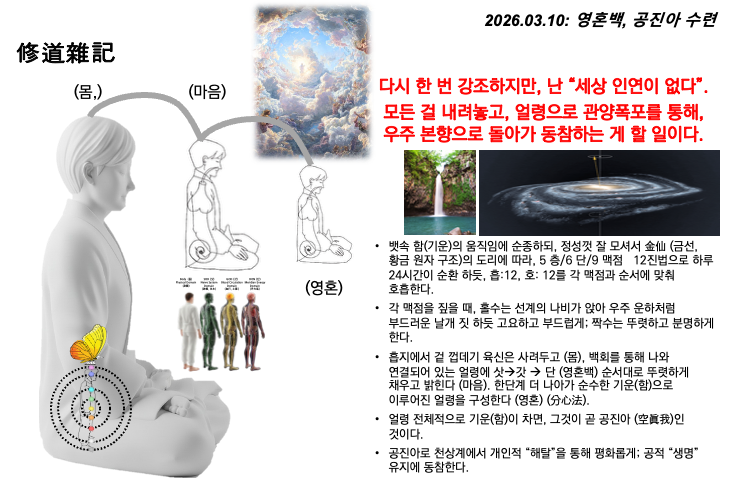
In the advanced stage (Jinki Danbeop), the integrated three cores form the true self, which may extend beyond the physical body and become perceptible outside the body.
Attention rises toward Baekhoe (百會), the crown point, and fills the subtle energetic structure known in Sundo as Eollyeong (얼령), often translated as the spiritual body.
This stage of practice is sometimes called Bunsimbeop (分心法), meaning the division or expansion of awareness. Consciousness becomes less confined to the physical body and more integrated with subtle energetic perception.
Research on long-term Sundo practitioners suggests that extended practice may correlate with increased psychological integration and spiritual development (Kim, 2002).
Figure 3
Energetic expansion and formation of the Eollyeong (spiritual body)

4. Realization of the True Self: Gong-Jin-A (空眞我)
As Qi circulation becomes refined, practitioners may gradually experience the emergence of Gong-Jin-A (空眞我), more refined true self.
This concept contains three characters:
• 空 (Gong) – emptiness, freedom from ego
• 眞 (Jin) – authentic truth
• 我 (A) – the self
Gong-Jin-A therefore represents the true self realized through emptiness and purified energy.
Importantly, this state does not represent escape from the world. Rather, it reflects a transformation of identity in which the individual recognizes their deeper connection with the whole of life.
Sundo literature describes this process as the harmonization of Jing (精), Qi (氣), and Shen (神) through disciplined cultivation (Kim, 2025).
5. The Deeper Purpose of Sundo Practice
The realization of Gong-Jin-A serves two interrelated purposes.
Personal Dimension
At the personal level, practice supports peaceful liberation (해탈). Liberation here refers to freedom from habitual attachments, emotional turbulence, and ego-centered perception.
Through sustained practice, the mind gradually becomes calmer, clearer, and more stable.
Universal Dimension
At the universal level, the practitioner learns to participate consciously in the ongoing cycle of life (생명).
Rather than imposing personal will upon nature, the practitioner becomes a cooperative participant in the larger rhythms of existence.
Traditional Sundo teachings emphasize that genuine cultivation ultimately contributes to human harmony and the balance of the cosmos.
Figure 4
Human participation in the cosmic cycle of life through awakened awareness


A Personal Reflection
My recent months of intensive Jinki Danbeop training have reaffirmed a fundamental realization.
The essence of Sundo practice is not merely the cultivation of energy.
It is the gradual awakening of awareness that allows a human being to live freely, harmoniously, and responsibly within the great cycle of life.
Liberation, in this sense, is not withdrawal from the world.
It is the ability to participate fully in life with clarity, humility, and awakened consciousness.
References
Brown, R. P., & Gerbarg, P. L. (2005). Sudarshan kriya yogic breathing in the treatment of stress, anxiety, and depression. Journal of Alternative and Complementary Medicine, 11(4), 711–717. https://doi.org/10.1089/acm.2005.11.711
Kim, H. (2002). The Tao of life: An investigation of Sundo Taoism’s personal growth model as a process of spiritual development (Doctoral dissertation, Saybrook Graduate School).
Kim, H. (2025). SunDo: An ancient Taoist breathing meditation journey toward enlightenment. Poil Publishing.
Original source: https://www.linkedin.com/pulse/liberation-participation-cycle-life-choi-phd-mba-me-72bve/
Liberation and Participation in the Cycle of Life
Reflections on Recent Kouksundo (Sundo) Somatic Practice Over the past eight months, I have been engaged in intensive Kouksundo (Sundo) practice, focusing particularly on Jinki Danbeop (眞氣丹法), an advanced breathing and internal cultivation method.
www.linkedin.com
2026. 03. 10