Awakening the Inner Center: The Five Levels of Sundo Somatic Breathing Practice
1. Introduction
In the Sundo tradition, breathing is understood as far more than a biological exchange of gases. It is the living current that connects Heaven, Earth, and Human—a dynamic rhythm through which the cosmos breathes itself into being. Within this worldview, the human body mirrors the universe, and each inhalation and exhalation becomes a dialogue between the microcosm and the macrocosm.
The Nine Sum-Maedeup (“nine breath knots”) describe energetic junctions where respiration, life-energy (Gi, 氣), and awareness converge. Each knot represents a living intersection of physiology and consciousness along the body’s central axis, known in Sundo as the Jungmaek (“central channel”). Extending from the crown of the head to the soles of the feet, this axis forms the vertical bridge linking the forces of Heaven and Earth.
Practice unfolds through five progressive levels of breathing, each activating a specific range of these nine energetic knots. As practitioners move from external respiration to the deepest primordial stillness, the breath evolves from something one does into something that is—the spontaneous pulse of life itself.
2. The Nine Sum-Maedeup: The Energetic Architecture of Breath
The nine knots can be visualized as luminous spheres aligned through the body’s centerline. Each has an anatomical reference point and a distinct energetic function:
- Fontanelle (Sum-gol / Cheonmun-hyeol 天門穴) – The crown or “Heaven Gate.” Here the individual breath opens to cosmic respiration and receives descending Heaven Qi.
- Third Eye (SOD Point) – The glabella at the forehead center. Called the “Insight Gate,” it awakens intuitive perception and aligns spirit with conscious awareness.
- Heart Center (GOD Point) – The cardiac plexus. This “Heart Knot” is the seat of compassion and balance, harmonizing emotional and spiritual respiration.
- Navel Center (Baekkop) – The umbilical region. It functions as the “Vital Reservoir,” focusing diaphragmatic breathing and converting essence (Jing) into energy (Gi).
- Sacral Center (DON / Doldan 氣海) – The base of the pelvis. This “Energy Root” stores and circulates life force through the spinal channel—the lower Danjeon of Sundo.
- Tailbone Point (Kkorippyeo) – The coccygeal base or “Earth Gate.” It grounds the internal flow and connects the practitioner to the Earth field.
- Knee Point (Hak-gol) – The knee joint, known as the “Crane Knot.” It bridges upper and lower currents, translating physical movement into energetic flow.
- Three Yin Meridian Point (Sam-eum-gyo) – Located above the inner ankle. It is the confluence of the Liver, Spleen, and Kidney meridians, gathering nourishing Earth Qi upward.
- Bubbling Spring (Yong-cheon) – The arch of the foot or “Earth Breath Gate.” Here ground energy enters, completing the Heaven–Earth–Human circuit of unity.
When these nine knots are awakened and harmonized, the entire body becomes a single breathing organism—a resonant field where physiology and spirit act as one continuum.

🌿 Table 1: The Nine Sum-Maedeup (숨매듭): Energetic Knots of Sundo Somatic Breathing
| No. Korean | Sundo Term | Romanization & Classical Name | Anatomical Reference | Energetic Function / Meaning |
| ① | 숨골 (Fontanelle) | Sum-gol, Cheonmun-hyeol (天門穴) | Crown / fontanelle | The Heaven Gate; apex where personal breath opens to cosmic respiration; entry of Cheon-gi (天氣)—Heaven Qi. |
| ② | 삿 (SOD) | Sot or Sod Point (Third Eye) | Glabella / forehead center | Insight Gate; awakens intuitive vision and aligns Shin (Spirit) with awareness. |
| ③ | 갓 (GOD) | Gat Point (Heart Center) | Cardiac plexus / center of chest | Heart Knot; seat of compassion and equilibrium; harmonizes emotional and spiritual breath. |
| ④ | 배꼽 (Navel) | Baekkop Point | Umbilical region / abdominal center | Vital Reservoir; focuses diaphragmatic and abdominal breathing; converts Jing → Gi vitality. |
| ⑤ | 단 (DON) | Doldan (氣海, Sacrum Center) | Sacrum / lower pelvis | Energy Root; lower Danjeon hub storing and circulating life force through the spinal channel. |
| ⑥ | 꼬리뼈 (Tail Bone) | Kkorippyeo Point | Coccygeal base | Earth Gate; grounding knot connecting internal Qi to the terrestrial field; initiation of the descending current. |
| ⑦ | 학골 (Crane Knee) | Hak-gol Point | Knee joint region | Bridge Knot; transforms kinetic motion into energetic flow; link between upper and lower circulation. |
| ⑧ | 삼음교 (Three Yin Meridians) | Sam-eum-gyo Point | Medial ankle above malleolus | Yin Confluence; convergence of Liver, Spleen, Kidney meridians; collects earth-energy (Ji-gi 地氣) upward. |
| ⑨ | 용천 (Bubbling Spring) | Yong-cheon Point (KI1) | Sole of foot / arch center | Earth Breath Gate; entry of ground Qi; completes the Heaven–Earth–Human circuit (Cheon-Ji-In Ilhwa). |
3. The Five Levels of Sundo Somatic Breathing
Level 1 – Geot-sum (External Breath)
At the first level, practitioners breathe through the whole body, activating all nine Sum-Maedeup (1–9). Attention expands from head to toe, coordinating respiration with posture and gentle movement. This full-body breathing awakens kinesthetic awareness, releases muscular tension, and synchronizes the skeletal and nervous systems.
Energetically, Level 1 cultivates somatic wholeness: inhalation draws Heaven Qi through the crown, and exhalation releases Earth Qi through the soles. The body becomes transparent to breath. Physiologically, this stage refines diaphragmatic rhythm and vagal tone—the foundation for all deeper breathing practices.
Level 2 – An-sum (Internal Breath)
Once external awareness stabilizes, breathing turns inward. An-sum activates seven inner knots (2–8), from the Third Eye to the Three Yin Meridian point. Breath becomes quiet, slow, and abdominal; chest movement subsides while the diaphragm and belly pulse gently.
Energy now flows along the Jungmaek as a bidirectional current. Inhalation guides Heaven Qi downward; exhalation lifts Earth Qi upward. This continuous Yin–Yang exchange balances the body’s poles and calms emotional turbulence. Internally, practitioners perceive breath as a soft wave rippling through connective tissue. The inner and outer worlds begin to feel like one breathing space.
Level 3 – Sal-sum (Vital Breath)
The third level engages five central knots (3–7)—Heart, Navel, Sacrum, Tailbone, and Knee. Here breath becomes energetic rather than mechanical. The body feels warm and buoyant, as Jing condenses into Gi and rises through the torso.
The pelvic and abdominal cavities act as crucibles for transformation. Subtle circular movements or slow walking may accompany practice to enhance circulation between the Heart Knot and the Crane Knee. Breath and movement fuse, producing rhythmic waves of vitality that pulse through the limbs.
Physiologically, this corresponds to coherent heart-rate and respiratory rhythms; psychologically, it generates alert calmness. Sal-sum is therefore known as the vitalizing breath—the moment when the human being recognizes itself as part of nature’s living energy system.
Level 4 – Eol-sum (Spirit Breath)
At the fourth level, attention narrows to the two inner knots (4–5)—the Navel and the Sacral Center. These form the cauldron of inner alchemy. Eol-sum, the “breath of spirit,” unites emotional and vital forces so that energy and awareness move as one.
Practice involves sensing a subtle oscillation between the navel and the sacrum. Inhalation gathers warmth in the abdomen; exhalation releases it into the sacral basin. Eventually the breath flows effortlessly, independent of conscious control. Within this circular exchange, water (descending energy) and fire (ascending energy) balance, producing an internal radiance often perceived as gentle light or vibration.
At this stage, breath becomes meditation itself. Emotional residues dissolve; compassion and clarity emerge naturally. The practitioner begins to experience breathing not as an action but as presence—a state of pure being sustained by rhythmic stillness.
Level 5 – Bon-sum (Primordial Breath)
The fifth and final level focuses exclusively on the Sacral Center (5 – DON / Doldan 氣海). All previous movements and distinctions converge here. Breath, energy, and consciousness condense into a single continuum of spontaneous respiration.
In Bon-sum, breathing is minimal or imperceptible. The entire body breathes as a unified field, and warmth from the sacrum expands upward along the spine and downward through the legs, completing the internal circulation of Heaven and Earth. Awareness ceases to alternate between inhaling and exhaling; instead, breathing continues on its own—an effortless rhythm of the Tao moving through the human form.
This is the realization of Cheon-Ji-In Ilhwa, the harmony of Heaven, Earth, and Human. The practitioner becomes a transparent conduit of universal life energy, embodying serenity, compassion, and creative vitality.
4. Integration of the Five Levels
The five levels operate as an ascending spiral of refinement. Each stage both contains and transcends the one before it:
🌿 Table 2: The Nine Sum-Maedeup Across the Five Levels of Sundo Somatic Breathing (Revised)
| Level | Korean Name | Breathing Dimension | Focus | Sum-Maedeup | Sundo Term | Romanization & Classical Name | Function / Meaning |
| 1 | 겉숨 (Geot-sum) | External breath – physical respiration through the entire body; harmonizing skeletal, muscular, and nervous rhythms | ①–⑨ | 숨골 → 용천 | Sum-gol → Yong-cheon | From crown (fontanelle) to soles (bubbling spring) | Whole-body breathing; awakens somatic awareness and alignment of all nine knots. |
| 2 | 안숨 (An-sum) | Internal breath – diaphragmatic and autonomic breathing; refining inner Qi circulation | ②–⑧ | 삿 → 삼음교 | Sot (Third Eye) → Sam-eum-gyo | From forehead to ankle | Activates internal Qi flow along the Jungmaek (central channel); harmonizes Yin–Yang balance. |
| 3 | 살숨 (Sal-sum) | Vital breath – energetic respiration; transformation of Jing (精) into Gi (氣) | ③–⑦ | 갓 → 학골 | Gat (Heart) → Hak-gol (Knee) | From heart center to knees | Generates vital energy; unites breath, circulation, and movement through the Five Middle Knots. |
| 4 | 얼숨 (Eol-sum) | Spirit breath – breath of awareness; harmonization of body and mind through subtle perception | ④–⑤ | 배꼽 ↔ 단 | Baekkop (Navel) ↔ Doldan (Sacrum) | Lower abdomen to sacrum | Integration of emotional and vital breath; inner alchemy of heart–belly connection (Shin–Gi unification). |
| 5 | 본숨 (Bon-sum) | Primordial breath – nondual respiration; merging of personal and cosmic breath | ⑤ | 단 (DON, Doldan) | Doldan 氣海 – Sacrum Center | Sacrum / lower pelvis | The root of life energy; condensation point of all breath; realization of Cheon–Ji–In Ilhwa (Heaven–Earth–Human unity). |
The path moves from gross to subtle, from external to internal, from voluntary to spontaneous. Ultimately, breathing ceases to be an act performed by the individual; it becomes the self-breathing of life itself.
5. Somatic and Scientific Dimensions
Modern science increasingly validates what Sundo practitioners have long experienced.
- Level 1 engages musculoskeletal and respiratory coordination, improving oxygen uptake and vagal tone.
- Level 2 corresponds to diaphragmatic regulation and heightened interoceptive awareness mediated by the insula and prefrontal cortex.
- Level 3 produces coherence between cardiac and respiratory rhythms, optimizing autonomic balance.
- Level 4 parallels meditative states marked by synchronized alpha-theta brain activity and reduced stress hormones.
- Level 5 reflects the resting baseline of non-dual awareness, where cortical prediction quiets and homeostatic harmony prevails.
Viewed through this lens, Sundo Somatic Breathing functions as a neuro-energetic training system integrating biological, emotional, and cognitive regulation. Each Sum-Maedeup may be understood as both a physiological hub—nerve plexus, endocrine center—and an energetic node transmitting signals between body and consciousness.
6. Teaching Progression
For instructors, the Five-Level framework offers a clear curriculum:
- Grounding (Geot-sum) – Establish posture and relaxed rhythm; feel the body breathe as a whole.
- Centering (An-sum) – Develop abdominal and diaphragmatic breathing; sense internal circulation.
- Energizing (Sal-sum) – Awaken vitality through gentle movement and stillness.
- Integrating (Eol-sum) – Refine perception; allow breath to merge with awareness.
- Transcending (Bon-sum) – Rest in spontaneous, uncontrived breathing; embody unity with the Tao.
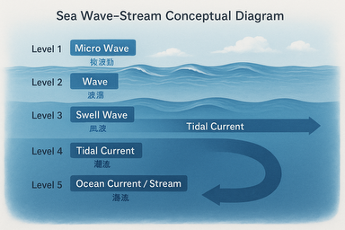
Simultaneity of the Five Levels of Breathing: The Ocean Analogy
The Five Levels of Sundo Somatic Breathing function like the layers of the ocean, where different wave forms coexist independently yet constitute one continuous sea. At the surface, Geot-sum resembles a micro-wave—small, visible ripples representing external, physical breathing. Beneath it flows An-sum, the wave layer, moderating the internal rhythm of the body’s energetic system. Deeper still, Sal-sum forms the swell wave, the powerful yet unseen circulation of vital energy. Below this, Eol-sum corresponds to the tidal current, guiding the rhythmic exchange between inner and outer forces. At the deepest layer lies Bon-sum, the ocean current, the primordial stillness from which all motion arises.
Each layer moves with its own rhythm and purpose, sustaining the ecosystem of the whole sea—just as each level of breathing simultaneously supports different dimensions of human life. The practitioner’s task is not to replace one with another, but to gradually deepen awareness, sensing the surface breath while attuning to the deeper currents beneath. As attention sinks through these layers, breathing becomes multidimensional—responsive to physical needs, emotionally harmonizing, energetically regenerative, and spiritually vast—like the living ocean that breathes through all its waves at once.
7. Ethical and Existential Dimensions
Sundo regards breath cultivation as inseparable from ethical cultivation. As respiration deepens, empathy and humility arise spontaneously. The practitioner feels interconnected with other beings and with the living Earth. The final realization of Bon-sum is therefore not withdrawal but participation—the expression of cosmic breath in everyday life. To breathe consciously is to live compassionately.
8. Conclusion
The Nine Sum-Maedeup outline the subtle anatomy of energy, while the Five Levels of Breathing describe the experiential path of transformation. Together they form the central pedagogy of Sundo Somatic Breathing—a living science of human integration.
Through disciplined yet gentle practice, the practitioner discovers that every knot of the body is also a knot of consciousness. When these knots are loosened, energy and awareness flow freely; when they are unified, the person becomes whole.
The journey from Geot-sum to Bon-sum is the unfolding of the human as a breathing cosmos. In the end, the highest form of breathing is no longer performed by the practitioner—it is the universe breathing through an open, embodied human being.
Key Takeaways: The Five Levels and Nine Sum-Maedeup
Sundo Somatic Breathing views respiration as the living rhythm connecting Heaven, Earth, and Human. The Nine Sum-Maedeup—energetic “breath knots” from crown to soles—form the body’s subtle architecture where life energy (Gi, 氣) and awareness converge. Practice unfolds through Five Levels of Breathing:
- Geot-sum (external breath) awakens whole-body awareness;
- An-sum (internal breath) refines diaphragmatic flow;
- Sal-sum (vital breath) circulates life energy;
- Eol-sum (spirit breath) integrates emotion and awareness;
- Bon-sum (primordial breath) unites human and cosmic respiration.
Like layers of the ocean, all levels occur simultaneously—surface waves and deep currents coexisting as one living sea. The practitioner gradually deepens attention from outer to inner, cultivating multidimensional breathing that nourishes body, energy, and spirit. Ultimately, Sundo breathing reveals that the highest respiration is effortless—the universe breathing through the human being.


