Somatic Leadership Development: Circulation of Blood, Qi, and Spirit (삿, 上丹田)
Leadership today unfolds in a boundaryless environment. Global interconnection, rapid technological change, and systemic complexity demand a form of leadership that goes beyond technical competence or charisma. Leaders must cultivate integration, presence, and principled discipline.
Eastern traditions such as Kouksundo (Sundo, 국선도), an ancient Korean Taoist practice, offer a holistic paradigm. Kouksundo frames leadership not only as a cognitive or social phenomenon but also as an embodied, energetic, and spiritual discipline. Drawing on Kouksundo, I propose a framework for Somatic Leadership Development that integrates three circulatory systems: blood (혈행, 血行), Qi (기운, 氣運), and spirit (삿, 上丹田). Authentic leadership emerges when these circulations are harmonized, guided by the Sundo principles.
Two Circulations of the Human Body
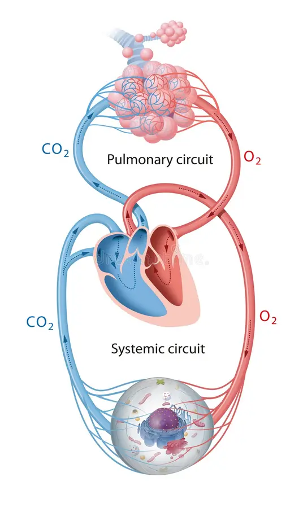
First, blood circulation sustains life through pulmonary (소순환, 小循環) and systemic (대순환, 大循環) loops, processes that are involuntary yet essential (Billman, 2020; Libretti & Puckett, 2023). This mirrors the material infrastructure of leadership—resources, structures, and systems.
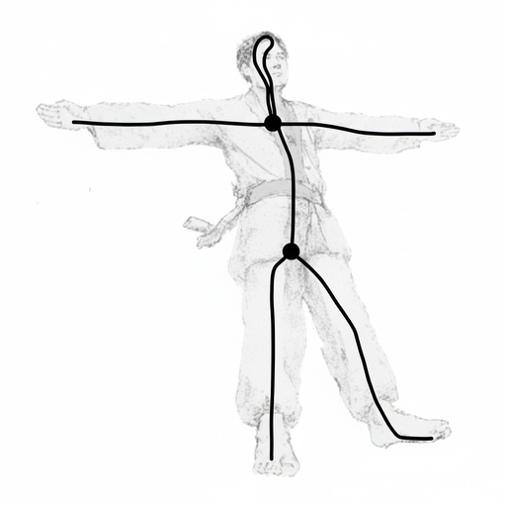
Second, Qi circulation represents the subtle flow of energy through meridians, expressed in the microcosmic orbit (임독유통, 任督流通) and macrocosmic pathways across 365 acupoints (三百六十五穴). Qi is not forced but escorted (侍), just as relational energy and vision in organizations must be nurtured rather than coerced. Research in acupuncture and meridian science suggests a physiological basis for these energy pathways within the extracellular matrix (Maurer et al., 2019; Qi et al., 2024; Zhang et al., 2015).
Together, blood and Qi form 기혈순환 (氣血循環), a metaphor for balancing tangible resources with intangible energy.
Spirit (삿, 上丹田) as Governing Principle
Kouksundo identifies the upper dantian (상단전, 上丹田) as the luminous seat of Spirit (삿). Spirit governs both blood and Qi circulation, providing discernment, ethical orientation, and visionary leadership. Physiologically, this resonates with the executive function of the prefrontal cortex, which regulates higher-order judgment (Billman, 2020). Spiritually, it embodies clarity, uprightness, and alignment with principle (도리, 道理). In leadership, Spirit ensures that actions are not reactive or expedient but anchored in integrity.
Three Domains of Leadership Function
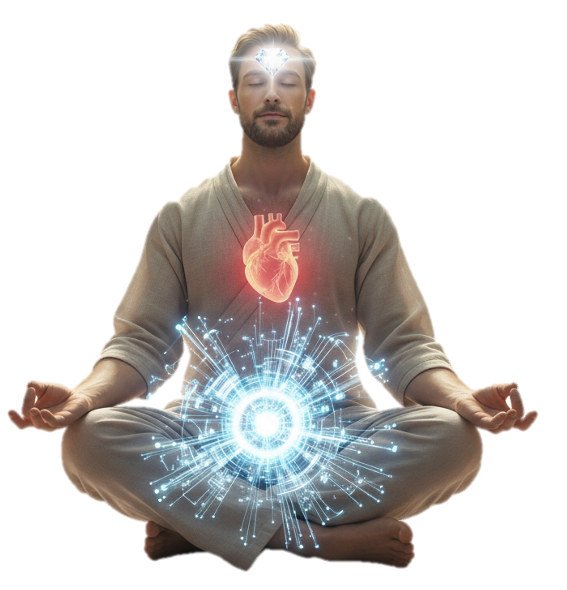
Leadership can be viewed through three overlapping domains: Body (신체, 身體 – psychomotor) as action and behavior; Heart–Mind (마음, 心志 – affective) as emotion, empathy, and relational connection; and Spirit (삿, 上丹田 – cognitive–consciousness) as discernment and ethical clarity. These domains operate both separately and together, requiring leaders to balance differentiation and integration.
Fragmentation and Transparency
Kouksundo describes two states of fragmentation and two states of transparency. 분심 (分心, divided heart–mind) denotes scattered emotions, while 분신 (分身, divided body–self) reflects disconnected actions. By contrast, 투심 (透心, transparent heart–mind) allows emotions to be held with clarity and empathy, and 투신 (透身, transparent body–self) embodies congruence between action and principle. The ultimate goal is 정도 (正道, the right path): principled alignment of body, heart–mind, and spirit.
Breath as Integrative Practice
Breath (호흡, 呼吸) is the gateway across all circulations. Physiologically, it sustains blood oxygenation and autonomic balance (Billman, 2020; Libretti & Puckett, 2023). Energetically, it escorts Qi through meridians (Zhang et al., 2015). Spiritually, it clears awareness and anchors presence. In leadership, breath-centered practice fosters resilience, clarity, and authenticity—qualities that inspire trust and systemic coherence.
Boundaryless Leadership and Elegance (풍류, 風流)
Modern organizations are boundaryless (Ashkenas, 1999). Leadership in such environments risks fragmentation, distraction, and ethical drift. Somatic leadership offers an antidote by grounding leaders in principle (도리, 道理) and discipline (규율, 規律). This produces 풍류 (Poongryu, 風流), or true elegance—not superficial style, but resonance between heaven and humanity. Just as blood, Qi, and spirit must circulate in harmony, so too must leaders integrate resources, energy, and principle to embody grace, presence, and systemic integrity.
Practical Applications
Leadership development informed by this model may include: breath training for resilience; somatic awareness of posture and presence; cultivation of emotional transparency (투심, 透心); training for embodied integrity (투신, 透身); ethical reflection to ensure 정도 (正道); and aesthetic practices (풍류, 風流) such as music, movement, and meditation to refine leadership presence.
Conclusion
The images of blood circulation, Qi circulation, and meditative spirit illustrate a model of somatic leadership rooted in Kouksundo. Guided by the principles of fragmentation (분심, 분신), transparency (투심, 투신), and principled discipline (정도), leaders move from scattered action to embodied authenticity. Just as breath escorts Qi and Qi animates blood, Spirit escorts leadership, aligning all domains toward wholeness. Authentic leadership, therefore, is not simply what we do but how we breathe, embody, and walk the right path—with elegance
References
Ashkenas, R. (1999). The boundaryless organization: Breaking the chains of organizational structure (Rev. ed.). Jossey-Bass.
Billman, G. E. (2020). Homeostasis: The underappreciated and far too often ignored central organizing principle of physiology. Frontiers in Physiology, 11, 200. https://doi.org/10.3389/fphys.2020.00200
Libretti, S., & Puckett, Y. (2023). Physiology, homeostasis. In StatPearls. StatPearls Publishing. https://www.ncbi.nlm.nih.gov/books/NBK559138/
Maurer, N., Kistner, K., Tack, C., van Roy, J., & Schmitz, C. (2019). Anatomical evidence of acupuncture meridians in the human extracellular matrix: Collagenous bands in the body align with acupuncture meridians. Journal of Integrative Medicine, 17(6), 409–416. https://doi.org/10.1016/j.joim.2019.06.004
Qi, W., He, B., Gu, Q., & Liang, F. (2024). Scientific exploration and hypotheses concerning the meridian system in traditional Chinese medicine. Acupuncture & Herbal Medicine, 4(3), 283–289. https://doi.org/10.1097/HM9.0000000000000128
Zhang, W. B., Tian, Y., Li, H., Hu, X., Su, Y. S., Xu, Y. J., & Huang, T. (2015). Classic and modern meridian studies: A review of low back pain and traditional Chinese medicine patterns. Evidence-Based Complementary and Alternative Medicine, 2015, 436369. https://doi.org/10.1155/2015/436369
==========
Sept 15, 2025 by Dr. Jeonghwan (Jerry) Choi


