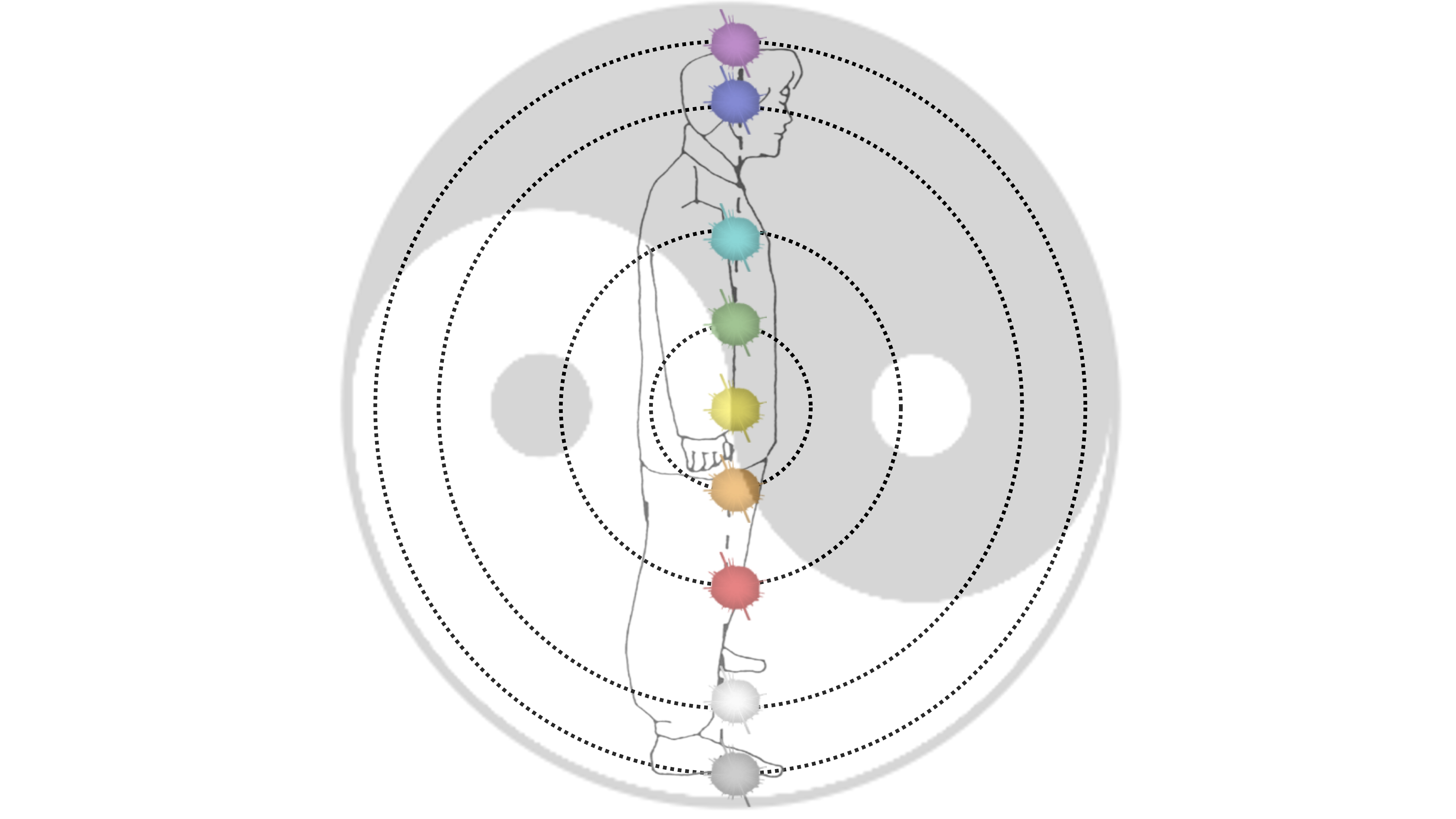
Across the world’s contemplative traditions, the human body is seen not only as a biological structure but as a living field of consciousness and energy. In Yogic philosophy, this is expressed through the seven chakras—seven subtle centers extending from the base of the spine to the crown of the head (Feuerstein, 2008). In contrast, the Korean Taoist discipline of Sundo (국선도, Kouksundo) teaches that human wholeness emerges through nine energetic centers, a model that extends beyond the seven-chakra schema. The ninefold framework reflects Sundo’s vision of the human being as a microcosm of the cosmos, harmonizing Yin (陰) and Yang (陽) through breath, posture, and mindful embodiment (Kim, 2002; Choi, 2025).
From Seven to Nine: The Tao of Completion
In Sundo philosophy, the number nine (九) symbolizes totality and the cyclic return to the source. Classical Taoist cosmology portrays existence as continuously unfolding through nine phases of transformation, marking the completion of one cycle and the beginning of another (Kohn, 2009). Sundo teachings likewise speak of “nine circulations of breath” and “nine stages of practice,” representing progressive refinement of energy (Kim, 2025).
While the seven-chakra system of yoga charts vertical spiritual ascent, Sundo’s nine-gate framework integrates three grounding centers in the lower body, emphasizing that spiritual development must remain rooted in the earth. This mirrors insights from somatic psychology that stress grounding and embodiment as foundations for higher awareness (Johnson, 2015). The added lower gates stabilize vitality and ensure that energy flows cyclically between Heaven (天), Human (人), and Earth (地).
These three grounding points include:
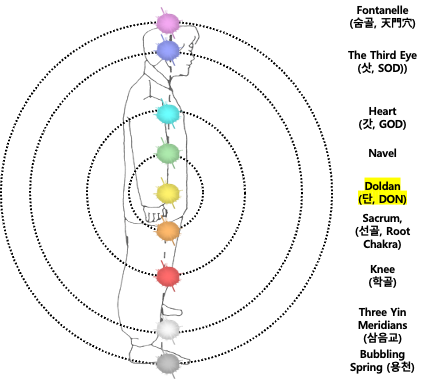
- Yongcheon (용천, Kidney 1) – “The bubbling spring,” located on the soles of the feet, connecting the body’s life energy with the Earth’s vitality.
- Sam-eum-gyo (삼음교, SP6) – Situated near the inner ankle, where the liver, spleen, and kidney meridians converge, harmonizing the flow of Yin energy.
- Hakgol (학골) – The knee-level energy gate, which stabilizes balance and connects emotional and kinetic energy with grounded physical strength.
When combined with the seven traditional energy centers, these three grounding nodes form a ninefold circuit that unites the lower body’s vitality with higher consciousness. Importantly, in Sundo’s energetic anatomy, there is no distinct throat point; instead, the Sacrum (선골) or Root base (회음) serves as the key lower gate where energy converges and anchors the body’s central axis.
The Dynamics of Breath and Energy Circulation
In Sundo, breathing is not merely a physiological process but an energetic circulation (통기법, Tong Ki Beop). Each inhalation and exhalation moves Qi in a spiral through nine centers, converging in the Dol Dan-jari (돌단자리)—the “energy furnace” in the lower abdomen, comparable to the Dantian in Daoist internal alchemy (Kim, 2025).
During inhalation (吸), energy contracts inward, descending through four micro-vortices before gathering at the Dol Dan-jari. During exhalation (呼), energy expands outward through the same nine centers, expressing the cosmic rhythm of contraction (陰) and expansion (陽) (Choi, 2025).
The inward phase, or Yin cycle, refines consciousness by cooling the mind into clarity like ice-water (氷水)—a cognitive stillness that supports discernment and non-reactivity (Kabat-Zinn, 2003). It stabilizes emotional warmth within the abdomen, symbolized by the Dan Fire (丹火), representing compassion, empathy, and relational harmony (Goleman, 1995). The body, cultivated through Earth Virtue (土德), anchors these forces in action, embodying integrity and perseverance.
Conversely, the outward phase, or Yang cycle, radiates this cultivated energy throughout the entire somatic field. Energy ascends along the Governing Vessel (독맥), descends through the Conception Vessel (임맥), and circulates through the 365 acupoints (Kim, 2002). Expansion without grounding, however, risks dispersion; contraction without expansion risks stagnation. Thus, balanced breathing sustains both dynamic vitality and inner calm.

Mapping the Nine Centers: A Somatic Cartography
The Sundo energetic map can be visualized as a nine-point mandala uniting physical, emotional, and spiritual dimensions:
- Upper Triad (Heaven) – Crown, Pineal (상단전), and Brow centers, representing awareness, wisdom, and connection to the transcendent.
- Middle Triad (Human) – Heart (중단전), Navel (신궐), and Sacrum (선골, 회음), representing emotional balance, will, and rooted vitality.
- Lower Triad (Earth) – Hakgol, Sam-eum-gyo, and Yongcheon, representing grounding, stability, and the regenerative life force.
This holistic trinity parallels Bloom’s (1956) taxonomy of human learning—cognitive (head), affective (heart), and psychomotor (body) domains—yet expands it into an energetic continuum. Each triad functions distinctly yet integrates as one whole, reflecting the Chunbu-gyeong (천부경) axiom: “The One unfolds into the Three Ultimates, returning to the inexhaustible root” (Choi, 2025).
Somatic Integration and Leadership Application
Contemporary leadership research recognizes that effective leadership arises from embodied self-awareness and emotional regulation (Reb et al., 2014). The Sundo nine-gate model provides a psychophysical framework for cultivating this balance. Through breath, posture, and mindful presence, practitioners align cognition, emotion, and action with the flow of Qi, developing what Kouksundo calls the True Master (眞主) within—the inner consciousness that governs without coercion.
This practice cultivates three enduring qualities:
- Cognitive clarity – perception free from impulsivity or distortion.
- Emotional warmth – compassionate and steady relational engagement.
- Grounded embodiment – disciplined action guided by principle and integrity.
When these capacities harmonize, leadership transcends strategy or charisma; it becomes a lived expression of ethical alignment and inner coherence.
Conclusion: Completing the Circle of Energy
The Nine Energy Gates of Sundo form a comprehensive model of somatic wholeness. Through rhythmic contraction and expansion, practitioners attune their internal circulation to the cosmic pulse of Yin and Yang. Each breath becomes a microcosm of the universe’s creative cycle—an integration of stillness and movement, matter and spirit.
Ultimately, Sundo teaches that mastery does not mean transcendence away from the body but realization through it. By breathing through these nine centers—rooted in the Sacrum, grounded through the legs, and illuminated through the crown—one embodies the living Dao: the seamless unity of Heaven, Earth, and Human.
References
Avolio, B. J., & Gardner, W. L. (2005). Authentic leadership development: Getting to the root of positive forms of leadership. The Leadership Quarterly, 16(3), 315–338. https://doi.org/10.1016/j.leaqua.2005.03.001
Bloom, B. S., Engelhart, M. D., Furst, E. J., Hill, W. H., & Krathwohl, D. R. (1956). Taxonomy of educational objectives: The classification of educational goals. Handbook I: Cognitive domain. David McKay.
Choi, J. (2025). Self-mastery leadership: Becoming the real owner of oneself as a leader. Kouksundo Academia.
Feuerstein, G. (2008). The yoga tradition: Its history, literature, philosophy and practice. Hohm Press.
Goleman, D. (1995). Emotional intelligence: Why it can matter more than IQ. Bantam Books.
Johnson, S. (2015). Somatic psychology and the evolution of mind–body integration. North Atlantic Books.
Kabat-Zinn, J. (2003). Mindfulness-based interventions in context: Past, present, and future. Clinical Psychology: Science and Practice, 10(2), 144–156. https://doi.org/10.1093/clipsy.bpg016
Kim, H. (2002). The Tao of life: An investigation of Sundo Taoism’s personal growth model. Saybrook Graduate School.
Kim, H. (2025). SunDo: An ancient Taoist breathing meditation. Poil Publishing.
Kohn, L. (2009). The Taoist experience: An anthology. State University of New York Press.
Reb, J., Narayanan, J., & Chaturvedi, S. (2014). Leading mindfully: Influence of supervisor trait mindfulness on employee well-being. Mindfulness, 5(1), 36–45. https://doi.org/10.1007/s12671-012-0147-1
2025. 10. 15


